
Chan Sook Choi
This post is also available in: Français (French)
Meeting in partnership with Les Volcans
For group or school visits, please contact the VIDEOFORMES team by email (videoformes@videoformes.com) or by telephone (+ 33(0)4 73 17 02 17) at least 48 hours in advance. Thank you for your understanding.
The work:
The works of the Yangji-ri Archive (2025) form a complex constellation resulting from Chan Sook Choi’s long-term engagement with Yangji-ri. Located near the DMZ, Yangji-ri is one of 112 Minbuk settlements established by the government after the 1953 armistice. These “strategic villages” were designed as propaganda tools to demonstrate superiority over the North, yet they subjected residents to strict military surveillance.
Choi excavates the lives of women within this patriarchal structure. Under the former Hoju system, inheritance was exclusively patrilineal; war widows who cultivated the land remained legally invisible, unable to claim ownership. The video work 60Ho critiques this erasure, referencing how women were stripped of individuality and addressed by soldiers only by their house numbers.
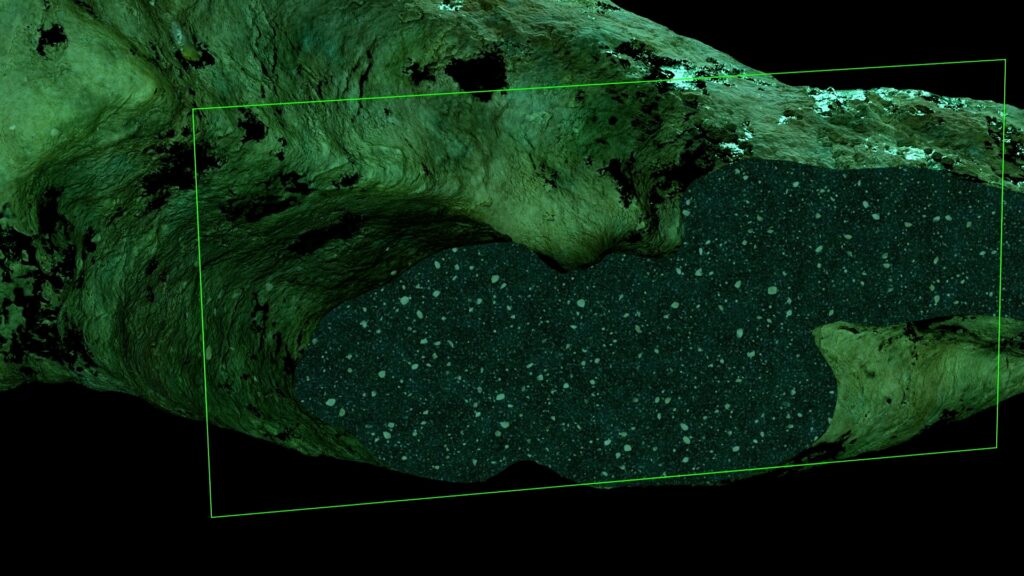
The Yangji-ri Archive materializes this history through concrete models of the village’s identical housing and name plaques that evoke funerary tablets. Alongside these traces, Artificial Sun centers on a radiant heater, highlighting the physical fragility of life in poorly constructed homes during harsh winters.
This inquiry expands in qbit to adam, which juxtaposes Yangji-ri with the Chajnantor Plateau in Chile, home to a massive international observatory. By connecting a militarized border village to a remote scientific site, Choi interrogates how states and institutions stake claims over territory—whether for ideology, resources, or knowledge—bringing visibility to the inhabitants and environments occupied by these vast systems.
The artist:
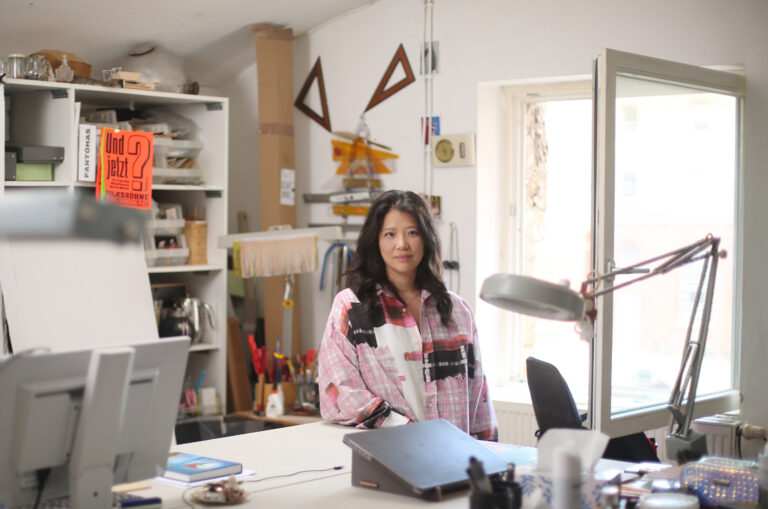
Chan Sook Choi’s interdisciplinary practice explores narrative experimentation via physical and mental migration. She addresses social issues by recording the vibrations and traces of fragile human and non-human beings. Winner of the 2021 Korea Artist Prize, she has had solo exhibitions at Kunsthalle Bremen (2025), Berlinische Galerie (2024), Taipei DAC (2020), Art Sonje Center (2017), and Humboldt Forum (2017).
ARTIST'S PORTRAIT
FOR MORE INFORMATION...
Interview by Fanny Bauguil (linking teacher at VIDEOFORMES)
- How would you describe this installation? What do we see? What can we hear? What’s taking place?
Upon entering the exhibition hall, the audience encounters various media connecting different times and spaces.
Visual: On one side, there are concrete models mimicking the uniform houses of Yangji-ri (a village near the Korean DMZ) and nameplates resembling mortuary tablets. On the other side, a large screen plays <qbit to adam>, displaying overwhelming landscapes: the red dust of Chile’s massive copper mines and the state-of-the-art ALMA Observatory standing atop a desolate desert. Additionally, in a corner, a red heater in the work <Artificial Sun> rotates endlessly, radiating heat.
Sound: The sounds of wind and machinery from the Chilean mines mix with the songs and interview voices of the grandmothers from Yangji-ri. The sounds of immense nature and the voices of forgotten individuals intersect to fill the space.
Action: The audience does not merely view the work; they walk through the ‘vibrations’ of the land the artist tread upon and the ‘stories’ of the people who lived there. The cold, dry sensation of the Chilean desert and the humid, warm atmosphere of Yangji-ri occur simultaneously within the exhibition space.
- What is it about?
This exhibition is a story about ‘Land,’ ‘People,’ and ‘Ownership.’
I explore whose land we are standing on and how macroscopic forces (such as the state or massive corporations) alter microscopic lives (individuals). Specifically, by connecting the lives of women in ‘Yangji-ri,’ a propaganda village created after the Korean War, with the stories of Chilean mines that supply the world’s copper, I tell the stories of beings who have been pushed away and erased from invisible places.
- Is this the first time this installation is presented to the public? Can you tell us a little about the process of developing the work to achieve this result?
These works are an organic combination of my long-term research project, the <Yangji-ri> series, and <qbit to adam>. While individual pieces have been introduced at venues such as the MMCA ‘Korea Artist Prize 2021’, this exhibition weaves them into a new context.
Process: I place great importance on ‘Field Research’—not just searching for data, but actually staying in the location. I lived in Yangji-ri village for seven months to interview residents and traveled to the other side of the globe to the Atacama Desert and copper mines in Chile (5,000m above sea level) for filming. This physical movement and embodied experience form the core foundation of my work.
- Which are the artists (all fields included) or more generally speaking, the artistic forms which nourish your creation, and possibly, the landmarks to which you refer in this installation?
Inspiration: I aim for Interdisciplinary Art that encompasses video, installation, and performance, without being bound by a specific genre. In my early days, I was inspired by the work of German artist Rebecca Horn, particularly regarding the body, space, and immateriality.
Landmarks: Two major landmarks appear in this work. One is ‘Yangji-ri,’ a civilian control village near the Korean DMZ, and the other is the ‘Chuquicamata’ copper mine and ‘ALMA’ observatory in the Chilean Andes. Although far apart, they are deeply connected in that the land is occupied by the state or capital.
- What are the problems, the constraints, the challenges … you met during its elaboration?
The biggest challenges were ‘Inaccessibility’ and ‘Physical Limitations.’
Obtaining permission to film in military control zones (DMZ) and strictly restricted areas like the Chilean mines and observatories was a major hurdle. Furthermore, enduring physical pain, such as altitude sickness while filming in a high-altitude desert at 5,000m, and managing the emotional weight of dealing with stories of war and migration were significant challenges in sublimating these experiences into art.
- Can you give one or more internet links where we can see your work?
Official Website: www.chansookchoi.com
- Can you give a few keywords that would fit well to your installation?
#Pushed_Away_and_Leaking_Out, #Movement, #Research_Based_Narrative, #Female_Narrative, #Artistic_Research
- A few words on your artistic development? When, in your life, did you have an interest in digital art? Can you live from your art work?
Growth: I moved to Berlin in 2001 to study Visual Communication and Media Art. Initially, I was more interested in moving images, sound, and space than painting on canvas. My interest in ‘Immateriality’ and ‘Moving beings’ naturally led me to digital media and video installation work.
Artist Note & Life: My work is a continuous process of capturing beings and sensations that are ‘Pushed away and leaking out.’ I chase the traces of movement and identities floating on borders, unraveling the narratives within them through media art.
Outside the studio, I teach students at a university, forming relationships on another level. To me, the university is not merely a place for transferring knowledge; it is a precious ground where future artists recognize each other as colleagues and form their first relationships in the art world.