
Mihai Grecu
This post is also available in: Français (French)
For group or school visits, please contact the VIDEOFORMES team by email (videoformes@videoformes.com) or by telephone (+ 33(0)4 73 17 02 17) at least 48 hours in advance. Thank you for your understanding.
The work:
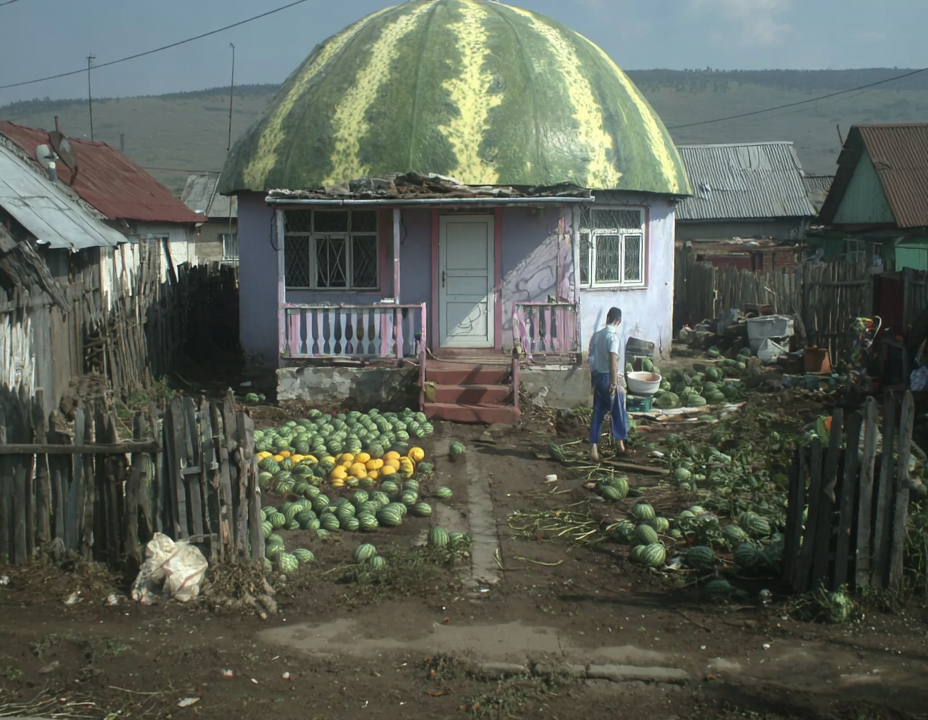
Melonland immerses viewers in a universe where the watermelon, omnipresent in Romanian summers, becomes the seed of a parallel world. Starting from this ordinary yet symbolically rich fruit, the work reinvents landscapes, architectures, objects, and situations as fragments of a collective dream. The images, generated and recomposed using AI models, shift between humor, poetry, and uncanny strangeness.
The project explores how a simple fruit can become an identity marker, a mythological motif, or a cultural mirror. Each image questions what we project onto visual symbols: rural traditions, popular imagination, beliefs, and the contemporary tensions amplified by social media.
Melonland also engages with the notion of post-truth: how an image, even an absurd one, can be interpreted in countless ways depending on personal narratives or emotions. AI becomes a revealer of collective fantasies, a “shared dream” where reality and fiction contaminate each other.
By blending folklore, pop aesthetics, surrealism, and viral visual culture, the work reflects on our current era—one in which symbols circulate faster than their meaning, and where a simple fruit can turn into a political sign, a cultural projection, or a new myth. Melonland is at once parody, emerging mythology, and a laboratory exploring how images shape our beliefs.
The artist:
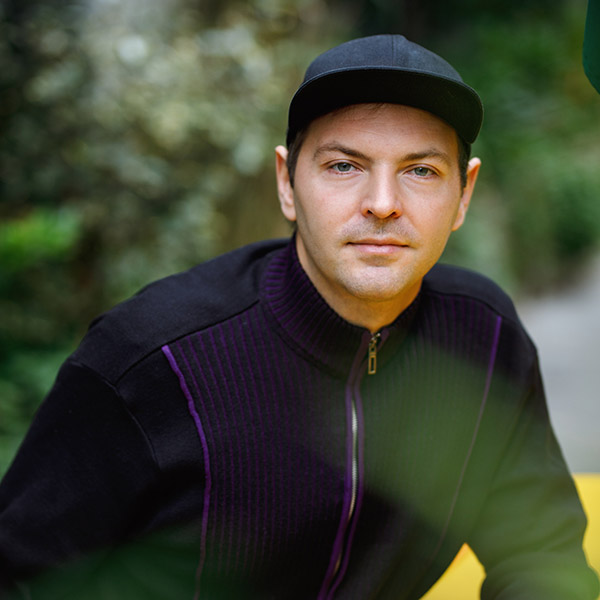
Mihai Grecu is a Romanian visual artist and filmmaker, a graduate of Le Fresnoy, living and working between Paris and Cluj-Napoca. His work, situated between experimental cinema and computer-generated imagery, explores dreamlike visions, political allegories and surreal objects. Winner of the French Union of Film Critics Award, his films and artworks have been showcased and awarded at international festivals (Videoformes, Rotterdam, Montreal, Videobrasil) and major exhibitions (Grand Palais, Cube, Ars Electronica, Biennale de l’Image Tangible etc.).
The artist’s website: https://mihaigrecu.net
FOR MORE INFORMATION...
Interview by Fanny Bauguil (linking teacher at VIDEOFORMES)
- How would you describe this installation? What can we see? What can we hear? How can we interact with it?
Melonland is a video project that imagines a world in which watermelons become cultural and architectural symbols, and are almost… alive.
We see landscapes, objects, and situations transformed by the surreal presence of the “melon.” Sometimes, watermelons become houses, cars, or strange creatures straight out of a dream.
There are generally no human voices, but ambient sounds that accentuate the sense of unreality.
The audience does not “do” anything in particular: they allow themselves to be swept along by the experience and wonder what is real, what is invented, and why a simple watermelon can become such a powerful symbol.
- What is it about?
Melonland explores the mixture of reality and imagination, and how images can transform the world around us. It is also a reflection on Romanian popular culture, where watermelons are ubiquitous in summer, but reinterpreted here in a fantastical and amusing way.
Ultimately, it is a story about post-truth, about how everyone can see what they want to see in an image, even when it seems absurd.
Est-ce la première fois que cette installation est présentée au public ? Parlez-nous du processus.
Is this the first time this installation has been shown to the public? Tell us about the process.
This is one of the first times that the Melonland universe has been presented as a complete art installation.
The project began with research into the symbolic role of watermelons in Romania, followed by hundreds of experiments with artificial intelligence.
Each image goes through several versions: nothing is “instantaneous.” I combine AI, manual retouching, editing, and conceptual reflection to make Melonland look like a collective dream and not just a generated image.
- Which artists or art forms inspire your approach?
For this project, I was influenced by:
– pop art and artists who have transformed simple objects into icons, such as Takashi Murakami or Kaws;
– surrealism, for its ability to transform everyday life;
– Romanian rural culture, its symbols and rituals;
– modern mythologies created on the Internet.
Melonland refers to this blend of popular culture, memes, humour, folklore, and digital images.
- What difficulties or challenges did you encounter?
The most difficult part is harnessing AI, which sometimes makes strange mistakes, rejects certain images, or lacks coherence.
Another challenge is creating a world that is funny, critical, and poetic, and that appeals to both children and adults.
We also have to choose which images to keep, which ideas to develop, and how to prevent the installation from becoming purely decorative.
- Where can we see your work ?
YouTube channel : @melonland8
Instagram : @thegrecu
TikTok : @melonland8
- A few keywords to describe the installation:
Watermelon, fantasy, post-truth, surrealism, folklore, humor, popular imagination, AI, new myths, melon universe.
- A few words about your artistic career: when did you start working with digital media? Are you able to make a living from it?
I have been working with digital imagery for over twenty years and with AI since 2019.
As a teenager, I was interested in imaginary worlds, science fiction, and manipulated images. Digital technology became my main field because it allows me to create entire universes from ideas.
Today, I make a living from my work, but like many artists, it’s a delicate balance of projects, commissions, residencies, and exhibitions.
Being an artist today means looking for new ways to see the world, even when it’s changing so fast.