
FemLink-Art
This post is also available in: Français (French)
For group or school visits, please contact the VIDEOFORMES team by email (videoformes@videoformes.com) or by telephone (+ 33(0)4 73 17 02 17) at least 48 hours in advance. Thank you for your understanding.
The work:
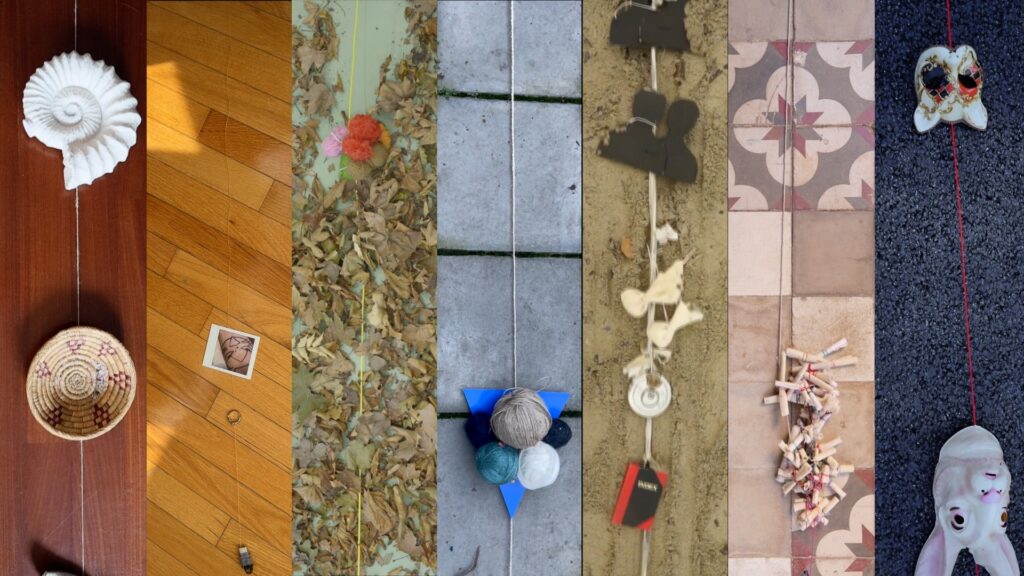
Our ability to see and understand the world is inextricably linked to what connects us to the complexity and meaning of objects, because they are tied to human existence and hold inexhaustible value in our encounters with ourselves and with others. Artists from the FemLink-Art collective explore the notion of human existence through their selection of artefacts. The image is traversed by their objects, linked to one another and scrolling across different floors. The artefacts cover the entire image just as they occupy the entire planet.
Credits:
Amaranta Sanchez (Mexico), Angelika Rinnhofer (Germany), M. Judge (USA), Cagdas Kahriman (Turkey / France), Carolina Saquel (Chile), Evgenija Demnievska (Serbia), Heejeong Jeong (Korea), Irina Gabiani (Luxembourg / Georgia), Jelena Miskovic (Serbia), Katia Efimova (Russia), Liina Siib (Estonia), Lucy Azubuike (Nigeria), Maria Papacharalambous (Cyprus), Marilena Preda Sanc (Romania), Melis Bilgin (Turkey), Minoo Iranpoor (Iran) , Mouna Jemal Siala (Tunisia), Ruth Bianco (Malta), Sima Zureikat (Jordania), Tania prilla (Indonésia), Véronique Sapin (France / Canada), Yue Liang (China)
Curators:
Crossings is a video installation created in 2026 to mark the 20th anniversary of the first public screening of a video work by FemLink-Art, the international collective of female video artists founded in 2005. The artists come from Europe, Asia, Africa and the Americas.
ARTISTs' PORTRAIT
FOR MORE INFORMATION...
Interview by Fanny Bauguil (linking teacher at VIDEOFORMES)
Who created this installation and why?
Crossings is a video installation created in 2026 to mark the 20th anniversary of the first public screening of one of the video works by FemLink-Art, the international collective of women video artists founded in 2005. The thirty participating artists come from 28 countries across the European, Asian, African, and American continents.
How would you describe this installation?
A space completely filled with objects that represent us, circulating everywhere without stopping.
What can we see?
Interconnected objects move across the image, traveling over all types of surfaces. Just like life is in constant evolution, the objects are drawn closer, intersect and drift apart, their trajectories responding to each other, creating a silent dialogue between experiences and sensibilities.
What do we hear?
The ambient sound of objects moving across different types of surfaces.
What is happening?
The objects move inside columns. There are seven columns in each image, which they enter and exit.
What is it about?
Why are artifacts studied by historians, archaeologists, primatologists, art historians, museologists, anthropologists…? Because they are connected to human existence and have incalculable value in our encounter with ourselves and with others. Our ability to see and understand the world is inseparable from what connects us to the complexity and meaning of objects. Each of the artists at FemLink-Art explores the notion of human existence through her selection of artifacts. As they travel across multiple surfaces, objects trace, brush against, smudge and mark: they write the world in their own way. The planet becomes a huge page on which humanity, through its artifacts, continues to record its transit.
Is this the first time this installation has been presented to the public?
Yes.
Can you tell us a little about the process of developing the work to achieve this result?
Each artist chooses objects for their symbolic value related to human existence. The objects are connected to each other. They cross the image from one side to the other on different types of surfaces (grass, sand, road, snow, leaves, tiles, floor, etc.). The images are then cut into narrow “strips” the size of the objects that have been dragged across different types of surfaces. The strips of images occupy the entire space.
What difficulties, constraints, and challenges did you encounter during its development?
There were few difficulties. Once the artist had chosen which artifacts she was going to use, the process was simple.
Can you give us one or more websites where we can see the work of the FemLink-Art collective?
What keywords would best describe your installation?
Over the last sixty years, humans have changed the world they live in more than ever before. Artifacts represent the imprint that humanity leaves behind and its dramatic consequences on the natural environment and life in general. Now, due to their number and materials, they pose a threat to our survival and that of other species.
A few words about your artistic background?
A book has been published in French about the collective, which we invite you to purchase on the FemLink-Art website. There, you will find answers about how we operate as well as analyses of hundreds of the collective’s videos.