
Hugo Arcier
This post is also available in: Français (French)
For group or school visits, please contact the VIDEOFORMES team by email (videoformes@videoformes.com) or by telephone (+ 33(0)4 73 17 02 17) at least 48 hours in advance. Thank you for your understanding.
The work:
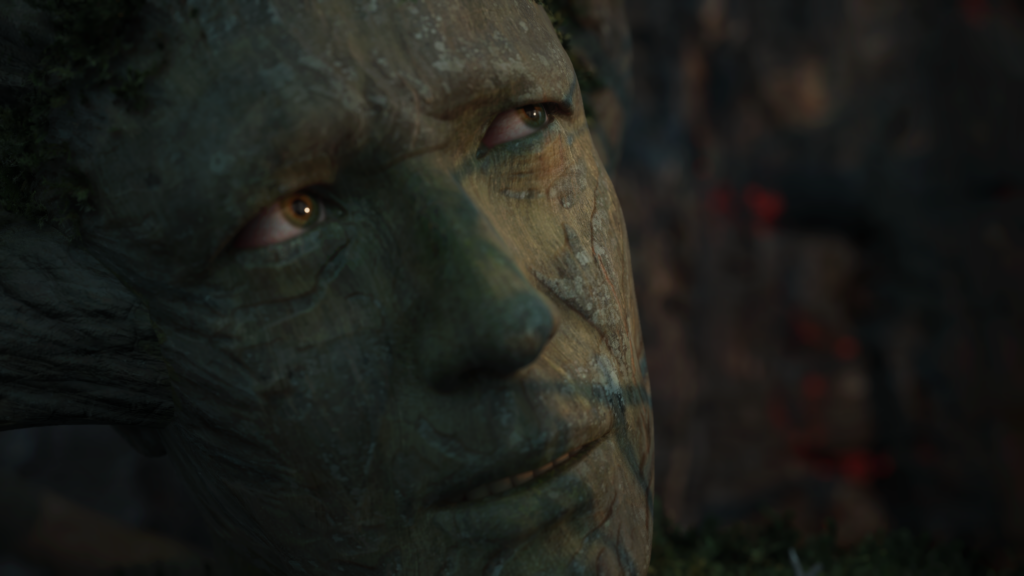
Yuri’s Metamorphosis is an immersive video installation by Hugo Arcier. Told by a human-plant hybrid narrator, the work explores climate disruption and the limits of technosolutionism. As geoengineering fails, a new idea emerges: hacking humans to absorb CO₂. Yuri, the first test subject, soon discovers the cost of this transformation.
With a visual style inspired by video game culture and a narration that emphasizes off-screen space and open interpretation, Hugo Arcier offers a chilling mirror of our world.
Credits:
© N°130 Creative Studio et Hugo Arcier
Texte de Patrick Bouvet
Comédien en performance capture (Yuri) : Vincent Berger
Musique d’Annabelle Playe
Création sonore de Hugo Arcier et Marc Siffert
Mixage audio de Marc Siffert
The artist:
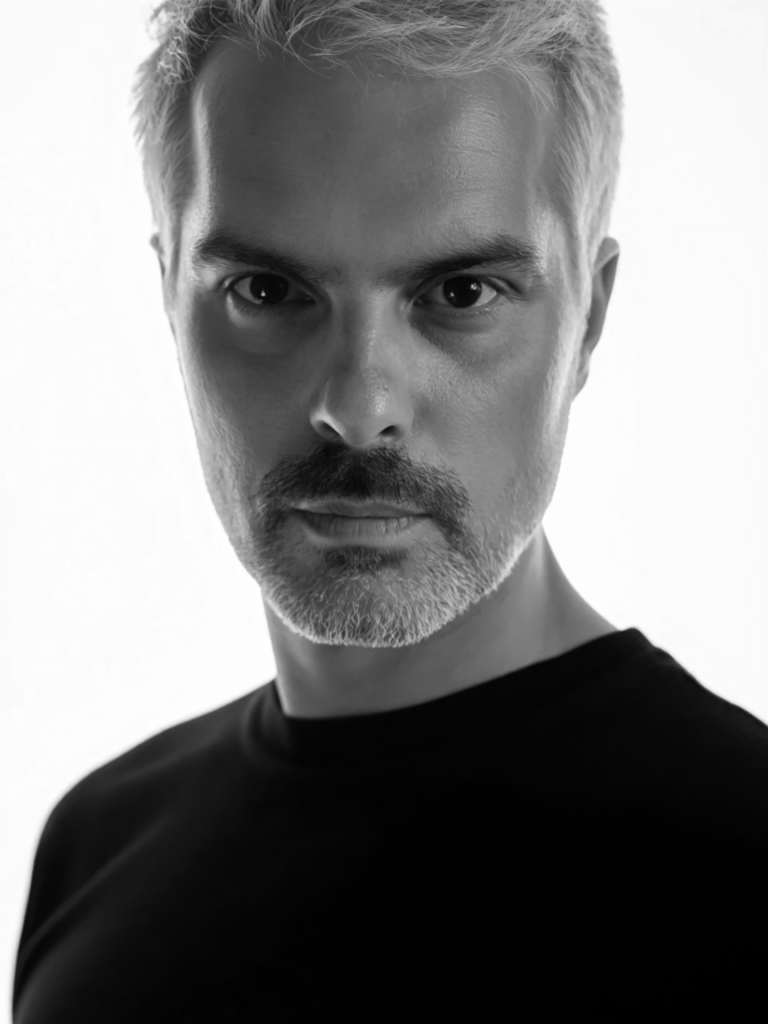
Hugo Arcier, an artist of the digital age, began his career creating visual effects for films by Alain Resnais, Roman Polanski and Jean-Pierre Jeunet. Since 2004, he has been creating works that combine computer-generated images and virtual worlds, transforming the virtual into poetic material. Exhibited at festivals (Némo, Mutek, Elektra, etc.), galleries and institutions (Palais de Tokyo, Le 104, New Museum), his works earned him the title of Chevalier des Arts et Lettres in 2016. In 2017, he founded the studio N°130.
ARTIST'S PORTRAIT
FOR MORE INFORMATion...
Interview by Fanny Bauguil (linking teacher at VIDEOFORMES)
- How would you describe this installation? What can we see? What can we hear? How can we interact with it?
Yuri’s Metamorphosis is an immersive video installation created by Hugo Arcier.
The work was started in 2020 and completed in 2025.
The installation takes the form of three separate screens. There is a dynamic interplay of editing and rhythm between these three screens, which can sometimes show three different shots simultaneously, or conversely, be composed of a panorama across two or three screens. The viewer navigates between a wide view of the three screens and a closer, more fragmented view on a single screen.
- What is it about?
This science fiction story is centered around a hybrid being, half-human, half-plant, who questions climate change and projects us into a possible future for humanity. The project takes a critical look at techno-solutionism and geoengineering.
- Is this the first time this installation has been shown to the public? Can you tell us a little about the process of creating the work to achieve this result?
It is! The images were created using Unreal Engine, a 3D engine originally developed for video games. Artificial intelligence is used occasionally in the film. It is powered by images generated via Unreal Engine to extend certain shots (lungs, CO2 capture plant…)
Yuri is a virtual character played by actor Vincent Berger, who lends his voice and movements via performance capture.
- Which artists (in all fields) or, more generally, which art forms influence your creative process, and what references, if any, are you alluding to in this installation?
The film draws on the visual codes used in video games: sudden appearances of objects rather than cross-fades, transparency of 3D surfaces (invisible from one side), visual bugs, etc. It is a new language in the making.
The installation, with its long tracking shots, also has a cinematic dimension, inspired by formalist filmmakers such as Stanley Kubrick, Andrei Tarkovsky, and Béla Tarr.
- What difficulties, limitations, and challenges were encountered during its development?
This was a long-term project. The fact that there are three screens means that many more CGI shots had to be created. Another challenge, of course, was creating a virtual character that could convey emotions. This character also had to be visible in a close-up. His eyes are particularly important in transmitting the actor’s performance.
- Can you give us one or more websites where we can see your work?
https://www.instagram.com/hugoarcier/
- A few keywords that would fit well with your installation?
Hybridisation, techno-solution, hypnosis.
- A few words about your artistic background? At what point in your life did you become interested in digital art? Are you able to make a living from your creative work?
I have been working with computer graphics in an artistic context since the beginning of my career. I make a living from my art, even though it requires a certain amount of flexibility.