
Christa Sommerer & Laurent Mignoneau
This post is also available in: Français (French)
For group or school visits, please contact the VIDEOFORMES team by email (videoformes@videoformes.com) or by telephone (+ 33(0)4 73 17 02 17) at least 48 hours in advance. Thank you for your understanding.
The work:
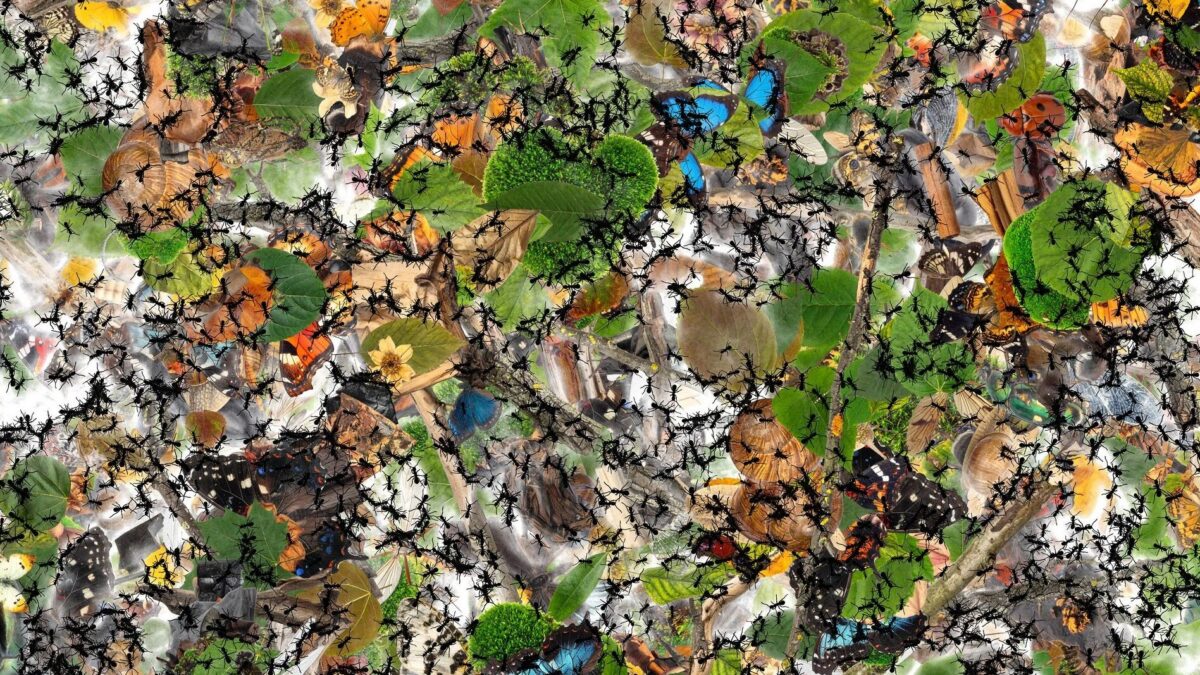
In the interactive installation Flaneur visitors can walk around on a large round projection surface. Their walking pattern and speed creates beautiful vegetations, consisting of leaves, flowers, branches and other organic elements. Strolling around fills up a colorful virtual garden which always recomposes itself. However digital ants also like these beautiful flora and come to quickly eat them up. They organize themselves to eliminate all what humans have created. Between one´s joyful creation of a garden and the removal cycle created by the ants, one might be reminded of the human impact on nature. Flaneur celebrates the aimless strolling around and the life cycle of creation and disappearance.
Credits:
©2026, Laurent Mignonneau & Christa Sommerer
Production VIDEOFORMES 2026
The artist:
Christa Sommerer and Laurent Mignonneau are internationally renowned media artists, researchers and pioneers of interactive art. Together they created around 50 interactive artworks shown in around 400 international exhibitions. Between 2021 and 2024 their 30 years retrospective exhibition toured from the ZKM in Karlsruhe, to the OK Center Linz, to the iMAL Brussels and the Azkuna Zentroa in Bilbao. This exhibition is accompanied by a comprehensive overview of their art works: “The Artwork as a Living System” Karin Ohlenschläger, Peter Weibel and Alfred Weidinger (Eds.), 2022, MIT Press, Leonardo Book series.
Site web des artistes : https://interface.ufg.ac.at/christa-laurent/
FOR MORE INFORMATION...
Interview by Fanny Bauguil (guest lecturer at VIDEOFORMES)
- How would you describe this installation? What do we see? What can we hear? What’s taking place?
CS&LM: In this installation visitors can walk around on a large round projection surface. Their walking pattern and speed creates beautiful vegetations, consisting of leaves, flowers, branches and other organic elements. Strolling around fills up a colorful virtual garden which always recomposes itself. However digital ants also like these beautiful flora and come to quickly eat them up. They organize themselves to eliminate all what humans have created. But as soon as visitors walk again, the virtual garden recomposes.
- What is it about?
CS&LM: Flaneur celebrates the aimless strolling around and the life cycle of creation and disappearance. It is a reminder that we humans are part of a large ecosystem where everything is connected. Our actions effect the environment and we are responsible for keeping a healthy balance with nature who feeds us.
- Is this the first time this installation is presented to the public? Can you tell us a little about the process of developing the work to achieve this result?
CS&LM: We have already created several interactive installations where visitors can interact with virtual nature, plants and insects. Flaneur is a new production that has not been shown before. In terms of production, we have developed several of our previous concepts, such as floor projection, creation of plants, and interaction with insects further. We have now combined these ideas into Flaneur and also enjoy the opportunity to project on a very large surface where several visitors can interact at the same time.
- Which are the artists (all fields included) or more generally speaking, the artistic forms which nourish your creation, and possibly, the landmarks to which you refer in this installation?
CS&LM: In general we love all art that deals with nature in a respectful way. From early landscape paintings, to botanical illustrations, to still life, and to more modern art where artists deal with the preservation and appreciation for nature, there are countless works, artists and genres that inspire us. In general we are situated in the area of media art, with a special focus on interactive art. Interactivity and audience participation gives us the opportunity to involve the public in a more bodily and tacit way. This is a powerful tool to make visitors feel the work through their bodies and to engage in the work and its message in a very direct and intuitive way.
- What are the problems, the constraints, the challenges … you met during its elaboration?
CS&LM: Well technical issues are of course always a challenge. However they might also inspire one to find new creative solutions that one did not consider before. In media art, the material often shapes the outcome and one should also be careful that the technology does not take over, but to keep the artistic message in the foreground.
- Can you give one or more internet links where we can see your work?
CS&LM: https://interface.ufg.ac.at/christa-laurent/
- Can you give a few keywords that would fit well to your installation?
CS&LM: interactivity, virtual nature, creation, human-plant-insect interaction, strolling around
- A few words on your artistic development? When, in your life, did you have an interest in digital art? Can you live from your art work?
CS&LM: It was a natural development. In Christa´s case she studied botany and modern art and came to digital art in 1991. Laurent had already worked with digital art since his childhood as he created his first electronic interfaces when we was 10. We met in 1992 and started to work together as we both saw a new potential in creating interactive artworks where humans can create digital nature by interacting with real physical nature. Our very first collaboration was Interactive Plant Growing, an installation that became an instant success and is widely known. It has been and is still shown in more than 100 exhibitions world-wide: https://interface.ufg.ac.at/christa-laurent/InteractivePlantGrowing.html
We can live from our art, as we have also worked as artistic researchers in Japan and have been teaching as professors of media art in Japan and Austria since 1997.