
Julie Stephen Chheng
This post is also available in: Français (French)
For group or school visits, please contact the VIDEOFORMES team by email (videoformes@videoformes.com) or by telephone (+ 33(0)4 73 17 02 17) at least 48 hours in advance. Thank you for your understanding.
The work:
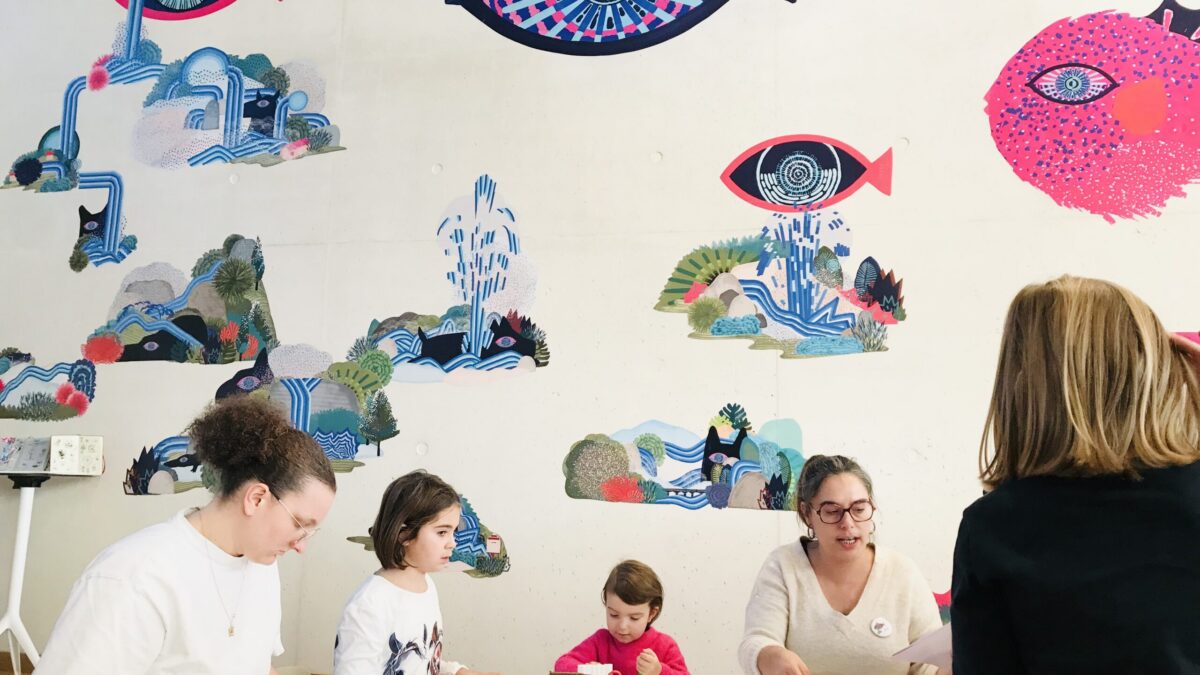
Water Eyes is an augmented-reality mural that tells the story of the spirit of water. Through the Fortune Teller AR app, visitors discover its vision of the world and access its own philosophy. Inspired by expressions from around the globe and various texts about water, Water Eyes invites us to see water as a daily source of inspiration.
Credits:
Texts and images: Julie Stephen Chheng
Animation: Thomas Pons
Sound Design: Apollo Noir
Developer: Julien Hognon
The artist:
Julie Stephen Chheng, a graduate of the Arts Décoratifs in Paris, explores paper and digital media in books, design and scenography. Author of numerous books, applications and interactive exhibitions, she has been in residence in Kyoto at Villa Kujoyama, in Hong Kong with the HKAC and in Auckland at Villa Antipode. Creator of Uramado AR and collaborator with Hermès, she is currently developing Fortune Teller and Paysages en construction.
Artist’s website: https://juliestephenchheng.com/
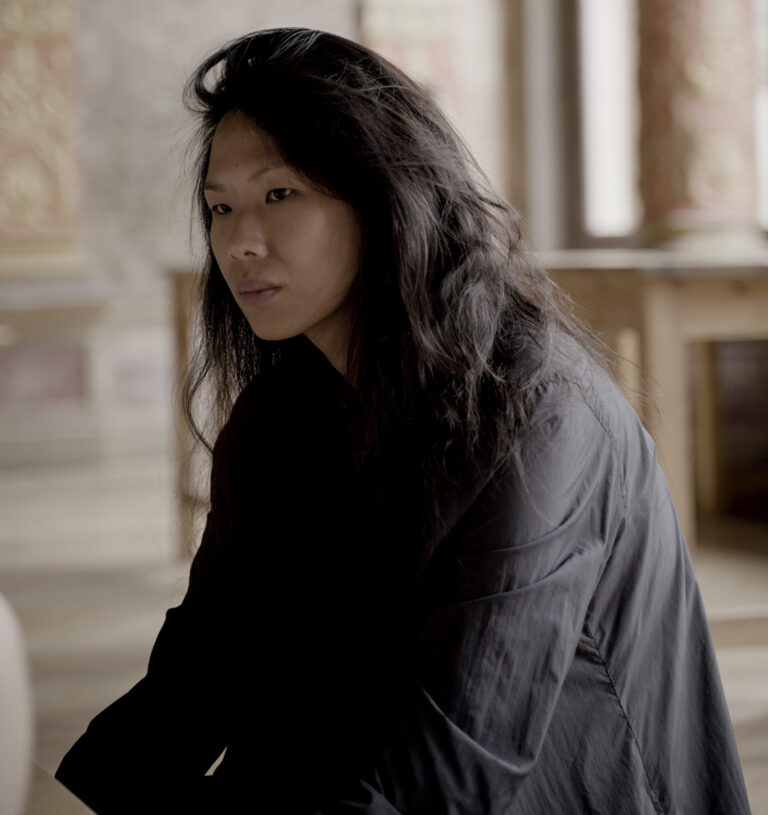
ARTIST'S PORTAIT
FOR MORE INFORMATION...
Interview by Fanny Bauguil (linking teacher at VIDEOFORMES)
- How would you describe this installation? What can we see? What can we hear? What can we do there?
Water Eyes is an augmented reality fresco that invites viewers to encounter the personification of water. Viewers download a free app called Fortune Teller AR and animate the eyes of the illustration. A filter and animations invite them to see through the eyes of water. Texts help them understand its vision of the world and grasp the philosophy of water through certain concepts related to the symbolism of water.
- What is it about?
It talks about water as a person. Overall, the texts are inspired by various writings from around the world, including Gaston Bachelard’s Water and Dreams.
- Is this the first time this installation has been shown to the public? Can you tell us a little about the process of creating the work to achieve this result?
Yes, it’s the first time.
For this project with the Route des Villes d’Eaux (Route of Water Cities), I worked in Montrond-les-Bains, mainly at the Les Passerelles multimedia library, but also in other places around the town. It’s a pleasant place, ideal for walks, with a beautiful cultural heritage, including a magnificent open-air castle that dominates the landscape.
I was able to stay there for a week with my partner and animator Thomas Pons to create the first drawings and animations. Living on site allows you to feel the “vibe” of the place. It’s also about encounters: talking with the locals, letting yourself be influenced, allowing the area and its people to permeate the project.
I didn’t know anything about water towns before this project. However, I did have some knowledge of water therapies, particularly in India and China. I find the idea of the Road of Water Cities very poetic, both for what it symbolizes: water as a therapeutic element capable of healing, and for its connective dimension: water connects people to each other, but also, on another scale, cities, territories, and even Europe.
In my work, I have always been sensitive to water: I have often depicted marine environments, rivers, lakes, tides… images that are highly symbolic. I have just returned from New Zealand, where water occupies a very special place and where people relate to it in many ways.
Living in Paris would almost allow me to introduce myself by saying that I live “south of the river” and that I was born “near the sea.”
Little by little, after several months, Water Eyes has become a fresco composed of modules, which is enhanced by an app. It tells the story of the Water character. With this app, you can literally see through its eyes: access its perception of the world. In this proposal, only the eyes come to life, an idea that I really liked because it offers a very powerful narrative gateway.
Finally, having everything built around the eyes allows for several levels of user experience:
– a combinatorial fresco, which can be different each time.
– a game with the location, here Les Passerelles, to integrate eyes onto the furniture and thus embody the character of water on elements of reality.
– and participatory workshops, where everyone can create their own version of the character of water, and thus take their guardian home with them.
I wanted to work simultaneously on the narration, animation, music, and images using the app to create an immersive, mysterious, and poetic world. I collaborated with Julien Hognon and Étienne de Volumique, as well as Apollo Noir and Thomas P., so that each could contribute their own perspective. The filters, an idea proposed by Julien de Volumique, particularly guided the project toward this notion of what the water sees, of multiple and shifting perceptions.
Visually, I wanted to evoke these visible and invisible waterways. Using a felt-tip pen (a felt technique), I seek to show that water is not only spatial: it also connects people and creates a common bond. The graphic lines are inspired by waterways, and the different characters we encounter, although numerous, are in fact one and the same being, sharing the same eye.
This unique eye travels between living beings and can be found in all the water sources that surround us. It embodies continuity, circulation, and the invisible bonds that exist between us.
- Which artists (in all fields) or, more generally, which art forms influence your creative process, and what references, if any, are you alluding to in this installation?
I am very interested in fashion and design: Issey Miyake, Bruno Munari, and Enzo Mari are designers who work with systems and mechanisms.
In this installation, more specifically, it is about learning more about the world of water, how it perceives others, its relationships, while at the same time discovering something about oneself. Two of its friends also play a role: the Eye of Thunder and the Eye of the Sky, secondary characters who enrich its worldview.
I also wanted to share various thoughts and concepts related to water that I find particularly interesting and revealing of a true philosophy of water, including:
– Wu Wei (non-action, Taoism)
– Mizu no Kokoro (水の心), “the spirit of water” (Japan)
– Panta Rhei (Greek: “everything flows”)
– Water and Dreams by Gaston Bachelard
And I have included several expressions from around the world that convey universal wisdom about water:
“Flowing water does not get moldy.” (Greek)
“Water is thin but heavy.” (India)
“Water is the oldest remedy.” (Finnish)
“Do not bathe in water you do not know.” (Senegal)
“Water flows and finds its way.” (China)
“When water comes, the canal forms.” (China)
“Still waters run deep.” (Germany)
“Like water off a duck’s back.” (France)
“The mind is like water.” (Japan)
“Like a fish in water.” (France)
Throughout the experience, the character of Water speaks to us. If we take the time to open ourselves up to it, we can access its advice, which can guide us in our daily lives.
More broadly, it is a way of evoking the multiplicity of perspectives: showing that our vision can be enriched when we put ourselves in someone else’s shoes and accept that everyone perceives the world differently. This applies equally for an animal whose vision differs from ours, for a personified image—such as water in this case—and for people from other places, other cultures, other social backgrounds, or who live with a disability.
It is an invitation to embrace differences and different points of view. That is the message I want to convey.
- What difficulties, limitations, and challenges were encountered during its development?
The main challenge is to use augmented reality as a storytelling tool rather than a mere gadget. To achieve this, we need to work on combining functionality, illustration, and animation.
- Can you give us one or more websites where we can see your work?
Instagram: julie_stephen_chheng
- A few keywords that would fit well with your installation?
Interactive, system, narrative, combinatorial narration, illustration
- A few words about your artistic background? At what point in your life did you become interested in digital art? Are you able to make a living from your creative work?
I graduated from the École des Arts Décoratifs in Paris with a degree in Printed Image, where I learned how to create books, from storytelling and illustration to graphic design, printing, and binding. I quickly became interested in Oulipo and system books as a way to explore different mechanisms for creating stories. Surrounded by people working in cinema, I set out to combine book-making techniques with digital tools to create worlds where the viewer’s choices and movements play a role and enrich the story.
I have been making a living from my personal projects for 6-7 years.